Sodium Citrate 3.8% Tubes Ensuring Clotting Accuracy
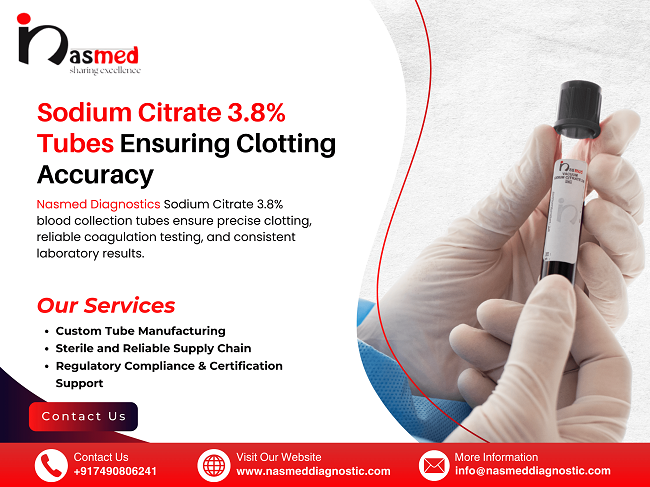
Nasmed Diagnostics: Best Sodium Citrate 3.8% Tubes for Reliable Laboratory Results
Modern diagnostic laboratories and hospital pathology departments have witnessed remarkable advancements over the past decade. With the adoption of advanced analytical equipment, faster testing protocols, and adherence to global standards, the focus on precise sample analysis has intensified. In India and international markets including the USA, UK, UAE, and Europe, ensuring patient safety and obtaining reliable test results is paramount. Sodium Citrate 3.8% tubes ensuring clotting accuracy, play a critical role in this process by guaranteeing precise and dependable blood sample collection for coagulation tests.
A vital, sometimes missed element in this setting is the blood collection receptacle. These aren’t merely holders—they are crucial for preserving the quality of blood specimens, ensuring that subsequent analyses yield precise and repeatable findings. Among these, Sodium Citrate 3.8% Vials have become a dependable option for clotting and sugar testing processes in contemporary labs.
Evolving Requirements of Current Testing & Medical Facilities
Labs worldwide face growing pressure to manage rising test volumes while maintaining quick turnaround times. Healthcare centres and testing networks in locations such as India, Singapore, Saudi Arabia, and other regions worldwide operate under strict international quality benchmarks. Facilities are expected to deliver swift results without sacrificing precision.
Some practical difficulties encountered by diagnostic centres include:
- High volume of testing: Hospitals and pathology networks frequently handle hundreds of specimens daily.
- Rigorous quality adherence: Benchmarks from ISO, CAP, and the FDA mandate proper specimen retrieval, handling, and examination.
- Cross-border and regulatory commitments: Testing facilities supplying specimens or supplies to facilities abroad must comply with international shipping, sterility, and labelling requirements.
- Uniformity across diverse locations: For operations spanning multiple cities or nations, standardised specimen-collection instruments are vital.
In this light, selecting the correct blood retrieval containers is not optional—it forms a cornerstone of operational superiority.
What Constitutes a Sodium Citrate 3.8% Vial?
In practical lab terms, a Sodium Citrate 3.8% Vial is either a vacuum-sealed or non-vacuum tube containing a 3.8% sodium citrate solution, acting as an anticoagulant. Seasoned lab personnel recognise its primary function is to prevent blood from coagulating, making it particularly suitable for clotting assessments, glucose measurement, and other standard analyses.
In day-to-day testing facility routines, these containers are utilised during vein puncture. Blood is drawn straight into the Vial, lightly blended with the anticoagulant, and then sent to analysis machines or centrifuges. Unlike general-use containers, citrate concentration is carefully controlled to maintain coagulation accuracy while preserving the blood’s natural properties, ensuring reliable test results.
Why Blood Collection Vials Are Fundamental for Accurate Specimen Retrieval?
The quality of a blood specimen begins the moment it leaves the patient’s vein. Inappropriate vials can jeopardise the sample, influencing test results and patient care. Sodium Citrate 3.8% Vials serve a key purpose in:
- Sustaining specimen integrity: The correct ratio of anticoagulant to blood prevents artificial clotting or dilution errors.
- Guarding against contamination: Sterile, individually sealed vials minimise the risk of microbial impurity.
- Result consistency: Facilities sending specimens to international collaborators benefit from uniform vials that yield consistent measurements.
For centres aiming for export-grade diagnostics, selecting blood collection receptacles is often the initial step in quality assurance.
Contribution of Blood Collection Vials to Dependable Test Outcomes
Using incorrect or substandard vials can substantially affect diagnostic precision. Common problems seen in hospital and pathology settings include:
- Inaccurate readings in clotting or glucose tests due to under- or over-filling the vials.
- Increased need for repeat testing, leading to delays in patient management.
- Erosion of patient confidence when findings are not uniform.
In routine lab procedures, using a standardised Sodium Citrate 3.8% Vial ensures that results from automated equipment or manual processes remain consistent, reducing repeat analyses and providing greater assurance to caregivers.
Considerations for Safety, Sterility, and Patient Welfare
Safety and absolute cleanliness are mandatory during blood collection. Well-engineered vials, such as Sodium Citrate 3.8% Vials, focus on:
- Sterilisation: Gamma- or autoclave-sterilised vials reduce the risk of microbial contamination.
- Airtight seal: Prevents spills during transit and ensures safe handling by phlebotomists.
- User-friendly design: Vials are shaped to minimise accidental needle pricks and allow for secure collection even in busy outpatient departments.
These considerations shield both patients and laboratory personnel while upholding diagnostic soundness.
Suitability with Modern Analytical Instruments
Current laboratories rely heavily on automatic analysers and centrifuges for precise testing. Sodium Citrate 3.8% Vials are compatible with:
- Automated coagulation analysers in medical facilities across the UK, UAE, and India.
- Centrifuge systems are used for separating plasma.
- Specimen transport mechanisms for inter-lab testing and export.
In everyday diagnostic functioning, compatibility ensures smooth integration, reducing human error and optimising process efficiency.
Manufacturing Excellence, Contents, and Vial Uniformity
Experienced laboratory supervisors recognise the merit of consistent manufacturing quality. Sodium Citrate 3.8% Vials are made under controlled circumstances to assure:
- Even content concentration: 3.8% sodium citrate liquid precisely measured.
- Uniform vial dimensions and vacuum level for accurate draw volumes.
- Safe, neutral vial materials that do not react with blood elements.
Other containers in the lab might hold agents like EDTA, separation gels, heparin, or fluoride, each serving a distinct analytical objective. Understanding these variations allows faenables to pick the appropriate test for the proper test category.
Storage, Longevity, and Handling Matters
Preserving vial quality from the maker to the lab is essential, particularly in hot, humid environments like India or during long international shipments. Appropriate storage and transit factors include:
- Temperature-regulated storage to maintain agent effectiveness.
- Durable encasement for shipment to regions such as North America, Europe, and Southeast Asia.
- Monitoring the expiration date to prevent compromised test outcomes.
Following these methods lowers specimen rejection rates and guarantees adherence to global norms.
Fiscal Prudence for Labs & Health Providers
While expense should never undermine quality, the long-term worth of premium vials like Sodium Citrate 3.8% Vials is considerable:
- Fewer rejected specimens and less need for re-runs.
- Reliable supply quality prevents workflow interruptions.
- Improved laboratory productivity, lessening the need for manual oversight and operational mistakes.
In hospital and pathology lab settings, these advantages translate into smoother running and improved patient results.
Conformity, Benchmarks, and Export Readiness
International approval of diagnostic supplies is a vital aspect for labs and vendors. Sodium Citrate 3.8% Vials comply with:
- ISO and CE benchmarks, ensuring worldwide acceptance.
- Buyer and hospital inspections, where vial excellence is closely examined.
- Export readiness, covering labelling, packaging, and sterility for markets such as the UAE, Saudi Arabia, the UK, and the USA.
Meeting these standards bolsters credibility and ensures continuous operation in both domestic and international arenas.
Incorporation into Hospital & Lab Operations
In hospital and diagnostic facility settings, these vials fit smoothly into existing procedures:
- Outpatient department collections for routine clotting and glucose assessments.
- Hospital laboratory networks with high-volume processing requirements.
- Centralised testing centres manage multiple collection points.
Utilising standardised vials simplifies operations and ensures testing accuracy across departments.
Instruction, Handling, and Disposal Protocols
Appropriate instruction is necessary for lab staff and phlebotomists. Sodium Citrate 3.8% Vials facilitate:
- Simple staff education via colour-coded or marked containers.
- Safe discard following biohazard waste guidelines.
- Awareness of biological hazards to prevent accidental impurity in lab and hospital settings.
This focus on safety and management ensures compliance with both local rules and international best practices.
Why is Selecting the Right Producer Significant?
Choosing a manufacturer with a proven track record in producing blood collection vials directly influences lab efficiency and trustworthiness. Key factors include:
- History in crafting uniform, high-grade vials.
- Grasp of export and regulatory mandates.
- Capacity to maintain a steady supply route across various territories.
Experienced manufacturers such as Nasmed Diagnostic Pvt Ltd ensure that labs globally—from India to Europe and North America—receive items that satisfy both quality and regulatory expectations.
About Nasmed Diagnostic Pvt Ltd
Nasmed Diagnostic Pvt Ltd is a reliable producer of diagnostic supplies, serving both Indian and global territories. With years of expertise in creating premium blood collection vials, Nasmed Diagnostic ensures that testing facilities, hospitals, and diagnostic networks have access to Sodium Citrate 3.8% Vials that meet worldwide benchmarks. Discover more about their offerings and proficiency at https://www.nasmeddiagnostic.com/.
Concluding Thought:
In the daily functioning of a diagnostic lab, the correct blood collection vial distinguishes between precise, dependable outcomes and inconsistent results. Sodium Citrate 3.8% Vials ensure coagulation accuracy for sugar testing, preserve specimen quality, support process efficiency, and adhere to global benchmarks. Opting for quality vials from experienced manufacturers improves patient care, lab performance, and international compatibility.
For diagnostic centres, healthcare administrators, and IVD vendors, investing in dependable blood collection consumables is foundational to achieving operational excellence.
Main Points to Remember
Diagnostic Precision: Consistent and trustworthy test findings.
- Specimen Safety & Cleanliness: Averts contamination and ensures patient well-being.
- Process Efficiency: Seamless fit into laboratory procedures.
- Expense Management for Labs: Reduces specimen rejection and repeat testing.
- Rising Worldwide Need: Supports diagnostics ready for export.
FAQS
1. How does Sodium Citrate 3.8% Tube help in accurate glucose testing?
- It prevents clot formation and maintains the blood sample’s natural properties, ensuring accurate test readings.
2. What is the recommended storage condition for these tubes?
- Store at room temperature, away from direct sunlight, ensuring the temperature remains within the manufacturer-specified limits.
3. Can these tubes be used with automated analysers?
- Yes, they are compatible with automated coagulation and glucose analysers used in global labs.
4. What is the typical shelf life of Sodium Citrate 3.8% Tubes?
- Shelf life ranges from 12 to 24 months, depending on storage and packaging, ensuring export-readiness.
5. Are these tubes safe for hospital and OPD collections?
- Yes, they are sterilised, leak-proof, and designed for safe handling in high-volume collection environments.
#BloodCollectionTube #DiagnosticConsumables #PathologyLab #MedicalDiagnostics #NasmedDiagnostic #IVDProducts #HealthcareManufacturing #GlobalDiagnostics #SodiumFluorideBloodCollectionTubes


Comments
Post a Comment