Why Quality Blood Collection Tubes Perform Better

Why Quality Blood Collection Tubes Perform Better – Nasmed Diagnostics
If you’ve ever had a lab report come back inconclusive — or worse, a sample that haemolysed before it even reached the analyser — you already know this truth: the tube matters just as much as the technique. In Indian diagnostic labs, from busy collection centres in Mumbai and Delhi to smaller setups in Indore and Vadodara, the quality of a blood collection tube directly shapes whether a patient gets the right diagnosis or goes through the stress of a repeat test. This article breaks down exactly why tube quality is a non-negotiable factor in modern diagnostics — and what manufacturing standards actually make a difference on the ground.
Why Choose Nasmed Diagnostics for Quality Blood Collection Tubes?
The short answer: because Nasmed Diagnostics was built specifically for this problem.
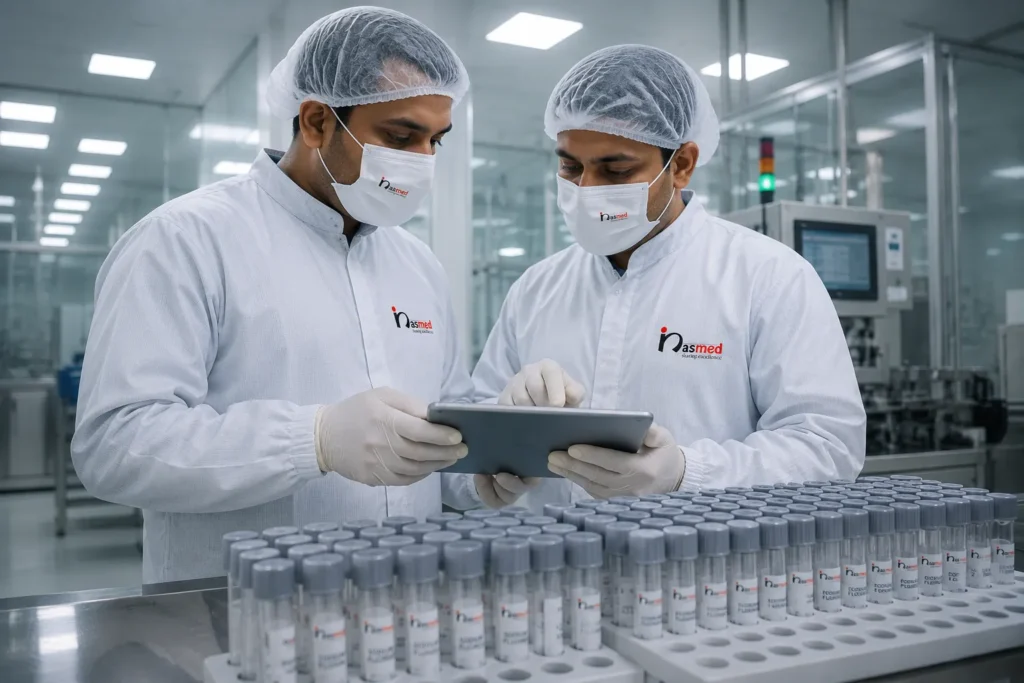
Operating from Gandhinagar, Gujarat, Nasmed Diagnostics Pvt. Ltd. manufactures diagnostic lab disposables inside a certified ISO 7 clean room facility (Class 10,000) — the same controlled environment standard used by pharmaceutical manufacturers. Under the leadership of Directors Kush Patel and Suril Shah, the facility maintains contamination-free production lines with a skilled team of quality experts who understand the specific demands of Indian hospital procurement cycles, regional lab infrastructure, and the regulatory expectations of CDSCO.
What sets this operation apart is not just the certifications — it’s the attention to material science. Every tube — whether a standard vacuum blood collection tube, a gel lithium heparin tube, a micro paediatric tube, or a cell-free DNA tube — is produced with precise additive concentrations, wall thickness tolerances, and closure integrity standards that align with international material guidelines.
Labs in Hyderabad, Bangalore, and Pune have increasingly started asking suppliers for documentation on additive stability and tube vacuum consistency. That’s where a manufacturer with genuine quality infrastructure gives procurement teams real confidence — not just a certificate on the wall.
Here’s how Nasmed Diagnostics supports lab managers practically: by offering a Free Product Consultation before purchase, helping you match tube type to your specific clinical test requirements — something that prevents costly mismatches between tube chemistry and analyser compatibility.
Our Blood Collection Tube Manufacturing Capabilities
Nasmed Diagnostics produces a comprehensive range of sterile blood collection tubes designed to cover the full spectrum of diagnostic needs:
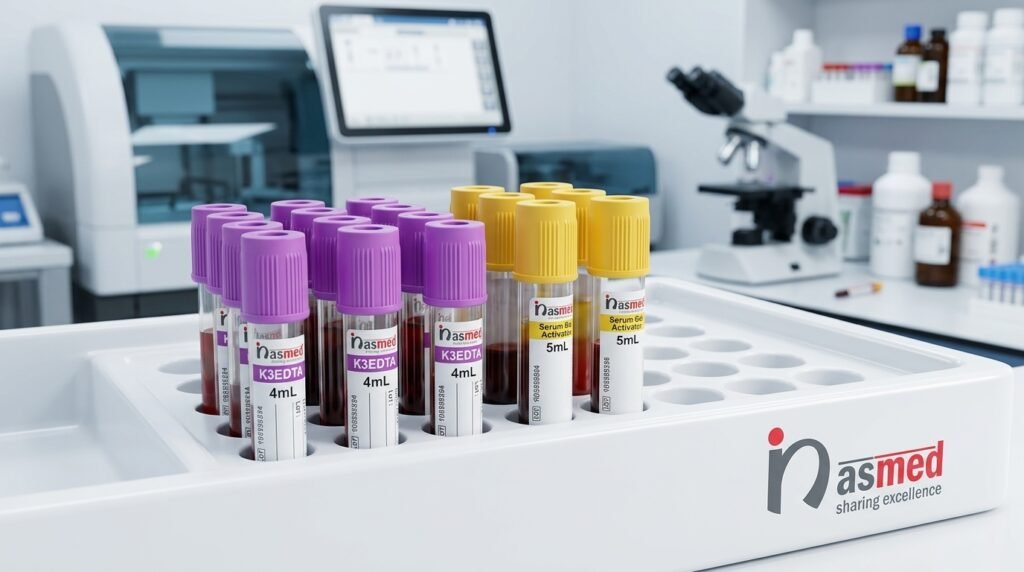
Vacuum Blood Collection Tubes are the workhorse of high-volume labs. The vacuum draw consistency directly affects fill volume accuracy — a variable that impacts coagulation tests, hormone panels, and chemistry profiles significantly. Our tubes are engineered for consistent vacuum retention, even in high-humidity storage conditions common in coastal labs in Chennai and Kolkata.
Non-vacuum blood collection tubes remain essential in neonatal wards, paediatric OPDs, and rural collection centres across Jaipur and Chandigarh, where vein access is limited and syringe transfer is the preferred technique. The material integrity of these tubes must be equally rigorous.
The micro paediatric tubes in the range are specifically calibrated for low-volume draws from infants and young children — an area where even small contamination or additive imbalance can produce completely misleading results in clinical chemistry panels.
For oncology diagnostics and liquid biopsy workflows gaining traction in centres in Ahmedabad and Surat, cell-free DNA tubes represent a highly specialised segment. These tubes require stabilisers that prevent white blood cell lysis post-collection — a standard that demands tight manufacturing controls.
Gel lithium heparin tubes are extensively used in biochemistry labs for serum separation. The gel barrier quality determines how cleanly the serum separates during centrifugation, directly affecting analyte recovery.
Beyond tubes, the facility also manufactures urine containers and a range of custom diagnostic lab disposables — making it a single-source supplier for labs looking to streamline procurement.

Navigating Regulatory Compliance & CDSCO Certification
In India, blood collection tubes fall under the Medical Devices Rules, 2017, regulated by the Central Drugs Standard Control Organisation (CDSCO). Since the inclusion of in-vitro diagnostics and medical disposables under mandatory CDSCO registration, procurement teams at hospitals and diagnostic chains have had to get far more careful about who they buy from.
CDSCO certified tubes come with a traceable regulatory file — including material declarations, sterility validation, and shelf-life data. For labs in Delhi and Mumbai that are NABL-accredited or working towards it, buying from a non-registered manufacturer creates a compliance gap that auditors will flag.
The ISO 7 clean room standard at the Gandhinagar facility ensures that particulate contamination levels during filling and sealing are controlled to Class 10,000 — meaning no more than 10,000 particles ≥0.5 microns per cubic foot. This isn’t just a quality badge; it’s the physical reason why tube-related pre-analytical errors are significantly reduced.
International material guidelines — including those from CLSI (Clinical and Laboratory Standards Institute) — specify additive-to-blood ratios, tube material compatibility with analysers, and closure reseal performance. Compliance with these standards, alongside CDSCO registration, is the dual benchmark that serious lab consumables India procurement is now measured against.
Local Suppliers vs Nasmed Diagnostics — Comparison Table
| Parameter | Typical Local Unregistered Supplier | Nasmed Diagnostics Pvt. Ltd. |
|---|---|---|
| CDSCO Registration | Often absent or pending |  Fully CDSCO Certified Fully CDSCO Certified |
| Manufacturing Environment | Open or semi-controlled areas | ISO 7 Clean Room (Class 10,000) |
| Vacuum Consistency | Variable, often untested | Calibrated, batch-tested |
| Additive Accuracy | Inconsistent concentration | Precise, CLSI-aligned ratios |
| Tube Range | Limited (2–3 variants) | Full range incl. Cell-Free DNA, Micro Paediatric |
| Custom Diagnostic Solutions | Not available | Custom labelling & formulations available |
| NABL Audit Documentation | Rarely provided | Full batch documentation provided |
| Pan-India Supply | Regional only | Supplies across Mumbai, Delhi, Bangalore, Hyderabad & beyond |
Step-by-Step Process – How We Deliver Quality Blood Collection Tubes
Understanding the manufacturing-to-delivery process helps procurement teams ask the right questions from any supplier — including us.
- Step 1 – Raw Material Qualification: Tubes start with medical-grade PET or glass, and additives sourced from verified pharmaceutical-grade suppliers. Every incoming batch undergoes chemical identity verification before it enters the clean room.
- Step 2 – Additive Preparation & Dosing: Liquid additives (EDTA, sodium citrate, lithium heparin, gel) are prepared under controlled conditions and dosed into tubes using automated dispensing equipment calibrated to ±2% accuracy.
- Step 3 – Vacuum Creation & Sealing: For vacuum tubes, the vacuum pull is applied in a precisely controlled chamber. Rubber stoppers are applied and crimped immediately to preserve vacuum integrity. This is where most low-cost manufacturers cut corners — and it’s exactly where sample quality breaks down.
- Step 4 – In-Process Quality Checks: Samples from each production batch undergo vacuum retention testing, closure force testing, and additive concentration verification before the batch is cleared.
- Step 5 – Sterility & Shelf-Life Validation: EO (ethylene oxide) sterilisation is applied where required, followed by sterility testing per Indian Pharmacopoeia standards.
- Step 6 – Packaging & Labelling: Tubes are packed in clean room conditions. Custom labelling for hospital chains or large diagnostic groups is handled at this stage.
- Step 7 – Dispatch & Documentation: Each shipment includes batch traceability documents, CDSCO registration copies, and quality certificates — the documentation set that NABL-accredited labs and hospital procurement teams actually need.
For labs looking for diagnostic tubes suppliers India-wide, this documented traceability is what distinguishes a reliable manufacturing partner from a reseller.
Real Client Case Study — How a Diagnostic Chain in Ahmedabad Resolved Pre-Analytical Errors
Client Background (Anonymised): A mid-sized diagnostic chain — let’s call them “Arogya Diagnostics” — operated 11 collection centres across Ahmedabad and Gandhinagar. They were processing roughly 800 samples per day across their network.
The Problem: Over a six-month period, their internal QC team flagged an unusually high rate of haemolysed samples — approximately 4.2% of all biochemistry tubes. Repeat tests were creating patient inconvenience, increasing turnaround time, and affecting their NABL audit scores.
Root Cause Investigation: When their lab director traced the issue, the primary variable was the blood collection tube supplier — a local distributor supplying tubes manufactured without documented vacuum consistency standards. The vacuum variation was causing partial fills, and the closure integrity issues were allowing micro-contamination post-collection.
The Switch: They contacted Nasmed Diagnostics through the website, requested a Free Product Consultation, and were guided through a tube qualification process — comparing their existing tubes against the Nasmed range on haemolysis index, fill volume accuracy, and stopper re-seal performance.
Outcome: Within 60 days of switching to vacuum blood collection tubes from Nasmed Diagnostics, their haemolysis rate dropped to 0.9% — well within CLSI-recommended thresholds. Their NABL assessors noted the improvement in pre-analytical documentation during their next audit cycle.
Mini Client Story: A senior procurement manager at a hospital in Surat once told us: “We thought tubes were tubes — same product, different label. After we switched to a properly certified manufacturer, our lab’s rejection rate fell noticeably. The technicians noticed it first.” That kind of ground-level feedback from hospital teams across Jaipur, Chandigarh, Kolkata, and Pune reinforces what quality manufacturing actually looks like in practice.
Faqs
1. Why do quality blood collection tubes perform better?
- Quality blood collection tubes maintain sample integrity, prevent contamination, and ensure accurate diagnostic results. They are manufactured with consistent vacuum levels and high-grade additives, reducing pre-analytical errors in laboratories.
2. How do premium blood collection tubes improve diagnostic accuracy?
- Premium blood collection tubes preserve blood components correctly during collection, storage, and transportation. This helps laboratories obtain reliable test results and minimizes the need for repeat sample collection.
3. Why are vacuum blood collection tubes preferred in modern laboratories?
- Vacuum blood collection tubes provide precise blood volume collection, reducing human error and ensuring standardized samples for accurate testing across hospitals and diagnostic centers.
4. Blood collection tube ki quality diagnostic reports ko kaise affect karti hai?
- Agar blood collection tube ki quality achhi na ho, to sample hemolysis, clotting ya contamination ka risk badh jata hai. Isse test reports inaccurate ho sakti hain aur patient diagnosis par asar pad sakta hai.
5. India mein laboratories quality blood collection tubes kyu choose karti hain?
- Indian diagnostic laboratories quality blood collection tubes choose karti hain kyunki ye NABL standards ko support karte hain, sample stability maintain karte hain aur reliable testing outcomes provide karte hain.
6. Kya high-quality blood collection tubes repeat testing ko kam karte hain?
- Haan, high-quality blood collection tubes sample rejection aur collection errors ko significantly reduce karte hain. Isse repeat testing ki zarurat kam hoti hai aur laboratory efficiency improve hoti hai.
7. What should healthcare providers look for in blood collection tubes?
- Healthcare providers should choose blood collection tubes with certified manufacturing standards, consistent vacuum performance, sterile construction, and reliable additives to ensure safe and accurate sample collection.


Comments
Post a Comment